Skip to content
You can bring your existing customers, vehicles, suppliers, products and invoice history into Workshop Software from CSV files, using the templates linked below. Most of the work, and most of the mistakes, happen before you press Import, so this guide spends as much time on preparing the file as on the import screen itself.
Please note: An import cannot be paused once it starts, and imported data can only be removed by Workshop Software, which also removes any invoices created since and carries a fee. Always import a test file of four or five rows first. Our support team does not troubleshoot self-managed imports. If you would rather we did the import for you, contact the Workshop Software support team about the paid import service.
Before you start
Imports are done one data type at a time, and the order matters because later files refer to earlier ones.
| Order | Data | Template | Why the order matters |
|---|---|---|---|
| 1 | Suppliers | Suppliers Import Template | Products link to a supplier through the supplier's Imported Id. |
| 2 | Products | Product Import Template | Each product's Vendor Id must match a supplier's Imported Id if you want them linked. |
| 3 | Customers | Customers Import Template | Vehicles link to a customer through a shared ID number. |
| 4 | Vehicles | Vehicles Import Template or Marine Import Template | Each vehicle row carries the ID of the customer who owns it. |
| 5 | Invoice history | History Headers Template and History Lines Template | History refers to customers, vehicles and products, so it goes last. |
Five rules apply to every file:
- Save as CSV, with the column names from the template in the first row.
- Fill every mandatory field, marked in yellow on the templates.
- Remove all commas from the data. In a CSV a stray comma shifts every column after it.
- Phone numbers may contain only digits and spaces. Strip brackets, dashes and letters.
- Keep leading zeros. Saving as CSV removes the 0 from the front of phone numbers and any other number that starts with one. Follow this guide as your last step before importing.
You will need a working knowledge of Excel or Google Sheets. The functions you are most likely to use are Text to Columns, Find and Replace, LEFT, CONCATENATE and VLOOKUP.
Prepare your spreadsheets
Customers
- Split names. First name and last name must be in separate columns. Excel's Text to Columns does this; Microsoft's guide walks through it.
- Company names. If a company name was split across several columns by that step, sort by each column from the last back to the third and merge them back together into a Company Name column. Columns one and two remain first and last name.
- Customer type. Every row needs
Cfor a company orIfor an individual. Sort by Company Name, type C in the first row that has a company name and drag it down to the last, then do the same with I for the rows that have only a first and last name. - Addresses. If suburb, state and postcode share one cell with the street address, split them out, merge the street parts back into a single Address column, and name the leftover columns Suburb, State and Postcode.
Vehicles
- Customer ID. Each vehicle row carries the ID number of its customer. If Jane Smith has two vehicles, her customer row and both vehicle rows share the same ID.
- Body type. Use a value from the body type list. If the body type is blank or not on the list, use
SEDAN. - Transmission. Use a value from the transmission category list. If it is blank or not on the list, use
N/A. - Boats and marine. Use the Marine Import Template instead of the standard vehicle one.
Products
- Product type code. Every product needs one of the single-letter codes below.
- Supplier link. Put the supplier's Imported Id in the product's Vendor Id column. Import suppliers first.
- Bundles. There is no bundle template. Import each bundle's name as a product, then open it in Workshop Software after the import and add its products manually.
| Product type | Code |
|---|---|
| Stock | S |
| Labour | J |
| Sublet repair | A |
| Consumable | W |
| Accessories | X |
| Tyres | T |
Run the import
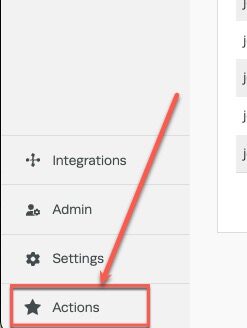
- In the left-hand sidebar, click Actions, then Import.
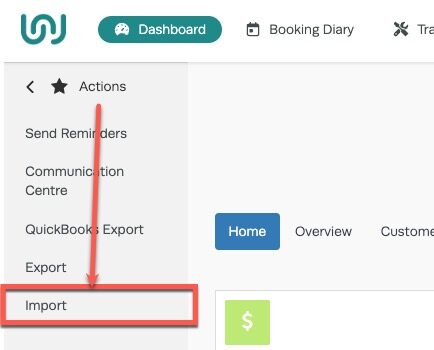
- Click the arrow at the right end of the blue bar for the type of data you are importing (Customers, Vehicles, Suppliers and so on) to expand it.

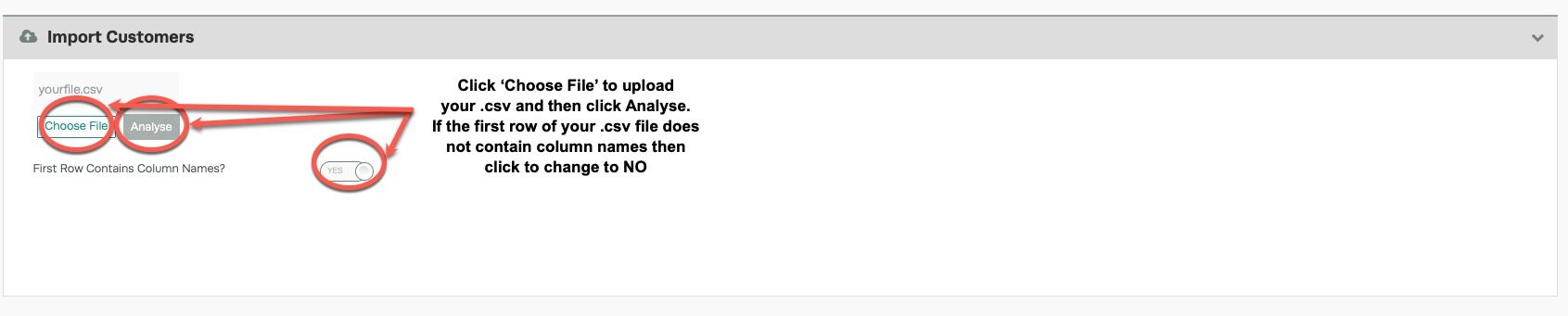
- Click Choose File, select your CSV, then click Analyze. Leave the first-row toggle on Yes if your first row holds the column names, which it will if you used the template. Set it to No only if your file starts straight into data.
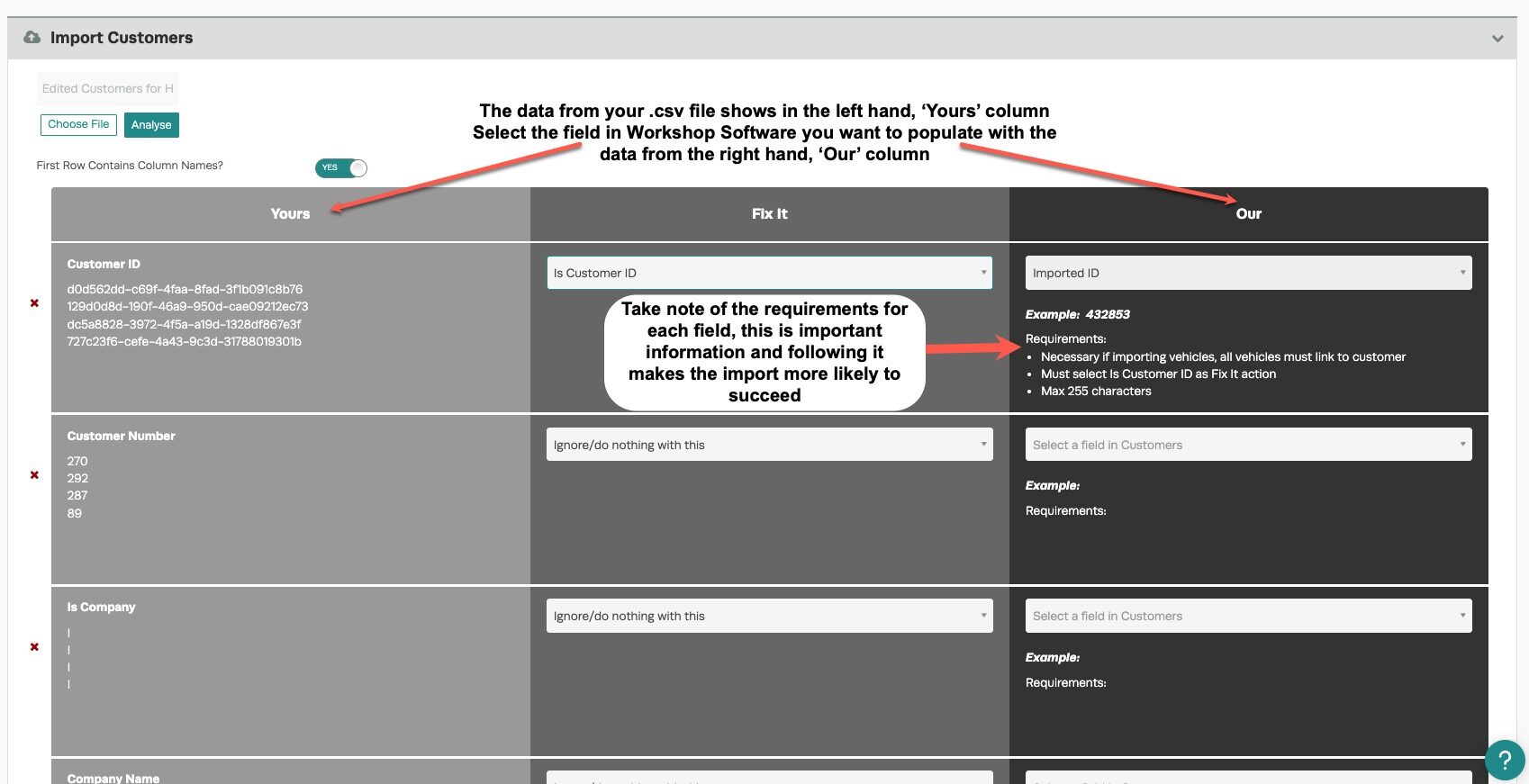
- Map your columns. The Yours column lists the headings from your file; match each one to the Workshop Software field in the Ours column. The Fix It column in the middle can reformat a column on the way in but is rarely needed if you prepared the file as above.
- When every column is matched, click Import Now at the bottom of the page. This is the point of no return, so for a first attempt make sure the file you chose is your four or five row test.

- Read the result bar. A green bar tells you how many records imported and how many did not. A red bar means the file had too many formatting errors and nothing was imported. In either case, the Event Log lists each rejected row with the reason in square brackets.
Check what did not import
- Go to Analytics, then Business Reports, then Log Reports, then Event Report.
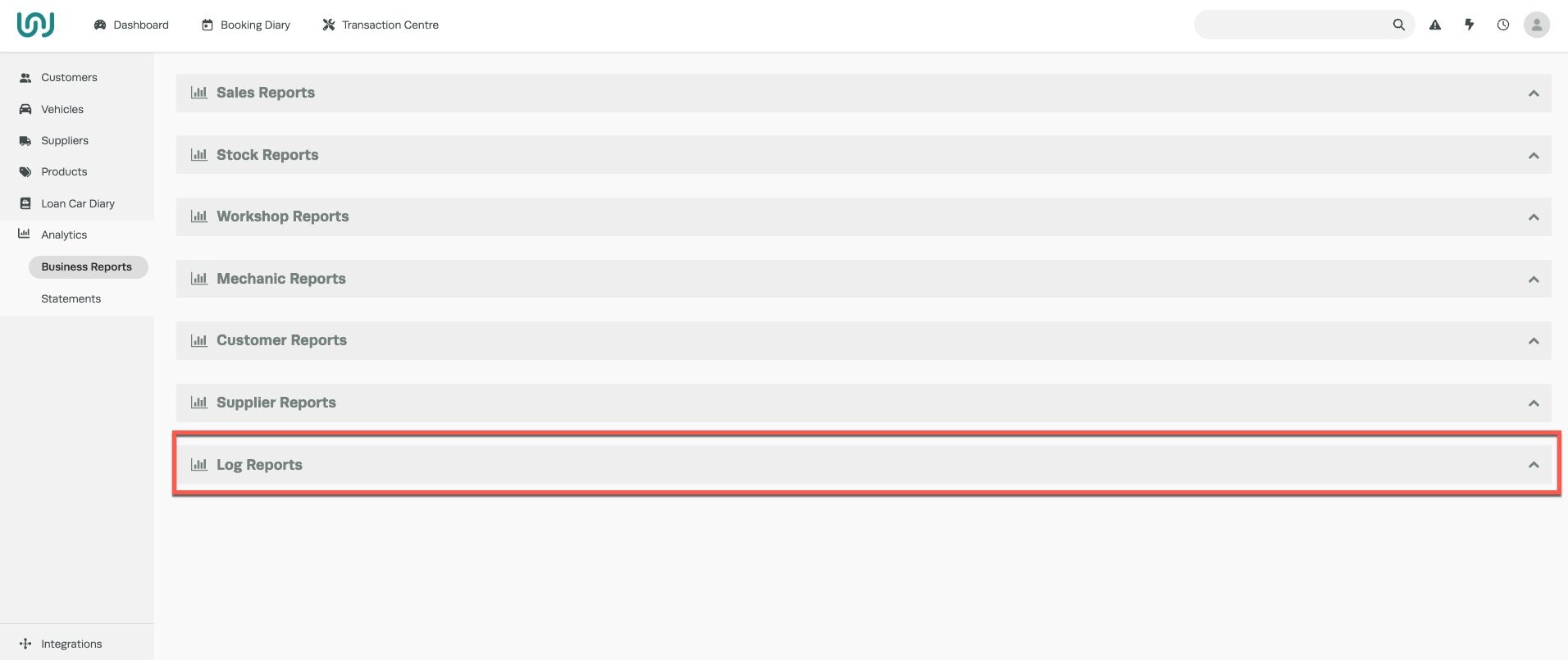
- Set the date range to today and click the printer or CSV icon. The report lists every record that was rejected, with the reason in square brackets, for example a missing mandatory field or a phone number containing letters.

- Fix those rows in your spreadsheet, remove the rows that did import successfully, and import the corrected file.
Frequently Asked Questions
Can I undo an import?
Not yourself. Contact Workshop Software to have imported data cleared. Clearing removes any invoices created since the import as well, and a fee applies, which is why we recommend the small test import first.
Why did some records import and others not?
The Event Report tells you row by row. The usual causes are a blank mandatory field, a comma inside a value, a phone number with brackets or dashes, a customer without a C or I type, or a vehicle whose customer ID does not match any imported customer.
Can I import my old invoices?
Yes, using the History Headers and History Lines templates linked in the table above.
Can I import bundles?
Only the bundle names, through the product template. The products inside each bundle have to be assigned in Workshop Software afterwards.
Why did my mobile numbers lose their leading zero?
Saving to CSV removes leading zeros. This guide shows how to keep them. Do it as the last step before you import.
Do I have to do this myself?
No. Workshop Software offers a paid import service, subject to availability and acceptance of a quote. Contact the support team for details.