Skip to content
Ask a workshop owner why customers stay, and most will say price. Ask the customers, and price barely rates a mention.
That gap is costing you money every day they put off a price review.
Only 1 in 5 customers leave for cheaper
Here’s a real scenario from the AAAA Beyond Service report, based on 1,003 Australian car owners*. Your regular workshop quotes $800 for a brake repair. A workshop you’ve never used quotes the same job for $600, a full 25% cheaper.
How many customers do you think would take the cheaper quote?
The answer is 21%. That’s only one in five on a saving that’s a quarter of the bill. Whatever number you had in your head, it’s probably higher than that.
The reason ties back to why people actually choose a workshop in the first place. When those same 1,003 people were asked why they chose their current workshop, 72% said trust and reputation. Only 30% mentioned price at all, and that was a multi-select question, so for most people, price wasn’t part of the decision at all.
Trust, it turns out, buys you a lot more room than most owners give themselves credit for. James Mitchell, CEO of Workshop Software, puts it plainly: “We’ve been working with workshops for 30 years. In that time I’ve never seen one lose a good customer over a price rise. I’ve seen plenty lose them over a surprise.”
Operators think price matters more than it does
Here’s the uncomfortable bit. The same research asked workshop operators what they think keeps customers coming back. Operators ranked price much higher than customers actually did. Customers put price fifth out of six.
If you’re holding off a price review because you’re worried about losing customers, you’re probably reacting to a fear your own customers don’t share.
So what does drive loyalty, if not price? Mostly the handover. Customers who get a face-to-face explanation from the mechanic are 25 points more likely to say they’ll definitely return. Customers who get a clear rundown of what needs fixing now versus what can wait are 21 points more likely. Neither one costs you a dollar, and both matter more to your customers than the number on the invoice.
James has seen the same pattern play out on the ground for years: “People don’t leave over $15 an hour. They leave over feeling like they got caught out.” His fix is simple: “The customers who take a rate rise without blinking are the ones who already get a written quote before the job starts, a text when something changes, and an invoice that shows what was actually done. Do those three things for six months and the rate rise is a non-event.”
Know your number before you change it
Before deciding how much to raise your prices, you need to know what you actually need to charge. Most workshop owners set their rate by looking at competitors rather than working backwards from their real costs, wages, overheads, equipment, non-billable time, and their own wage properly accounted for.
If you haven’t done that calculation, the gap between your posted rate and what you actually need to charge is usually a shock. Our free [Effective Labour Rate Calculator] will do the maths for you in a few minutes.
Nervous about putting your rate up? “That usually means you haven’t been showing people what they’re already getting. Fix that first and the rate rise gets a lot easier”, says James.
When to raise your prices
Three signals tell you it’s time:
- You’re fully booked with a waitlist. Seven in ten Australian car owners would wait more than three days to get into their preferred workshop. If customers are waiting for you, your price is too low.
- You haven’t raised prices in more than two years. Vehicle repair costs have risen faster than general inflation over the past year. If your rate hasn’t moved with them, your margin has shrunk quietly without you touching it.
- The surcharge ban. From 1 October, workshops are absorbing the merchant fee rather than passing it on. It’s a legitimate, external, publicly understood reason to review your pricing properly, rather than just tacking on another 0.9% and moving on.
How much, and how to say it
If you’ve never raised prices, 5 to 10% is usually manageable for customers who already value your work. One clear increase is cleaner than a series of small ones, constant small rises create more anxiety for customers than a single transparent review.
Three rules for communicating it:
- Be confident, not apologetic. The moment you apologise for your prices, you invite negotiation.
- Keep it simple. One clear statement, no over-explaining.
- Give notice. Thirty days is professional and respectful.
“Put the rate up, tell people before it happens, and give them a reason: another technician on the floor, better diagnostic gear, cars turned around faster. Include context and your good customers will be onboard,” James explains.
The words themselves don’t need to be complicated: “We’ve reviewed our pricing to make sure we’re sustainable as a business and delivering the quality our customers expect. Our new rates will take effect from [date].”
That’s it. If someone pushes back with “that’s too expensive,” acknowledge it and hold your ground: “I completely understand. We’ve worked hard to make sure we’re delivering real value for every job, and that’s what the new rate reflects.” Then stop talking. Don’t negotiate; don’t offer a discount.
What actually happens next
The customers who leave after a reasonable price increase are almost always the most price-sensitive, the ones who haggle, dispute invoices and take up the most time. The customers who stay are your best customers: loyal, trusting, not driven by price.
Revenue typically goes up even when volume dips slightly, and the workshop itself feels less stressed, with fewer difficult jobs and better margins. Think of a price increase as a filter. The customers who leave after a fair, well-communicated increase were never your best customers to begin with.
While you’re reviewing the numbers
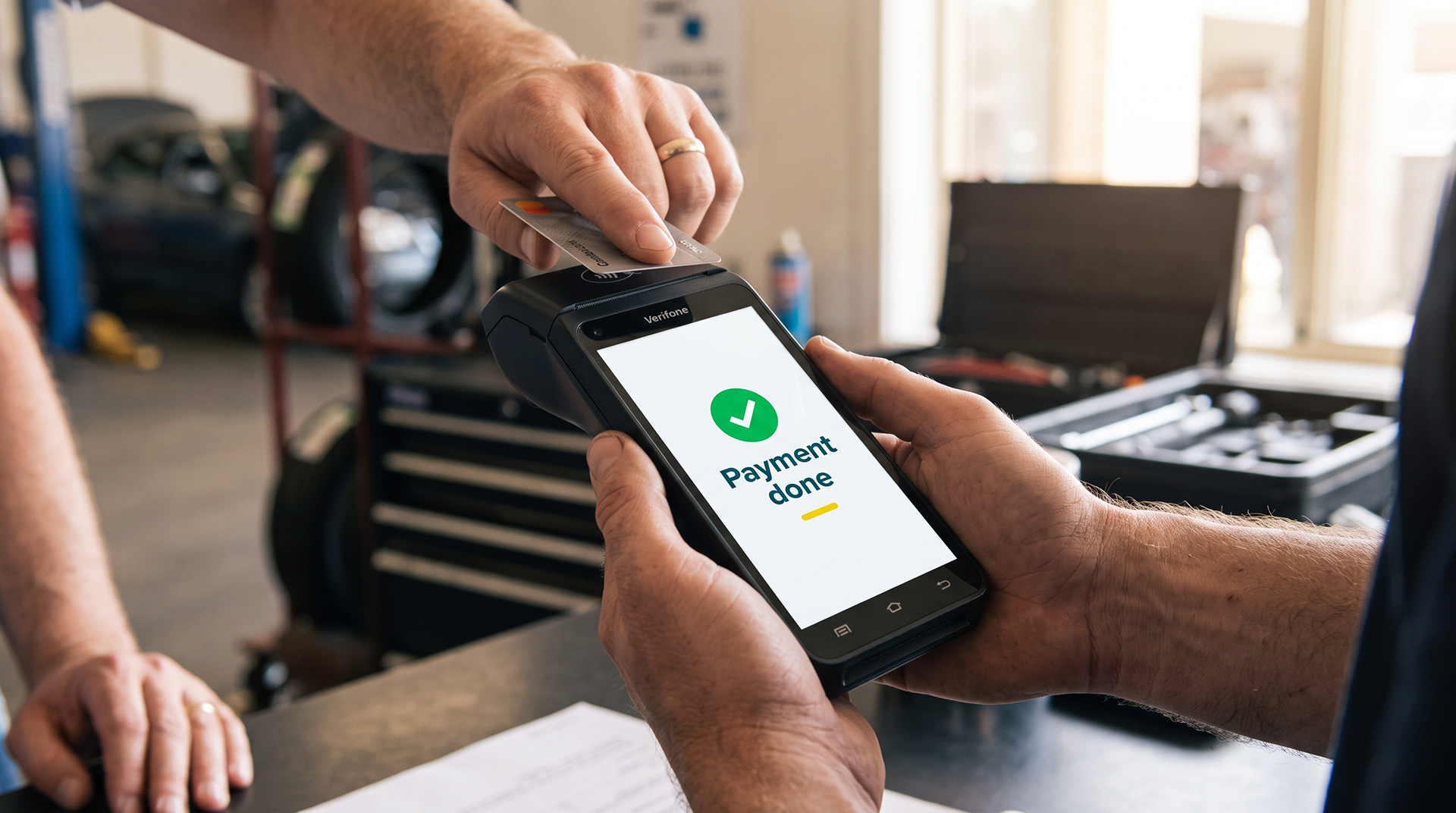
If you’re raising your prices, it’s worth making sure the rest of the customer experience matches, including how they pay. A customer watching someone manually key in a payment amount has a small, subconscious moment of doubt. WorkshopPay removes that moment entirely: the invoice is the payment, reconciled automatically, with online payment links so the job closes cleanly before the car even leaves the bay.
Your next step this week: calculate your effective labour rate, compare it to what you’re currently charging, and write your one-sentence communication.
If you’d also like a hand looking at your payment setup at the same time, book a free personalised workshop payments consult with no cost and no obligation.
We’re covering this in more detail, along with practical fixes for each stage, in the next session of our webinar series on Thursday 24 September at 1 pm (AEST). You can register here.
*Source: AAAA/Fifth Quadrant, Beyond Service report, June 2026, based on 1,003 nationally representative Australian consumers and 30 independent workshop operators. Additional data from a 2025 global consumer study by UserTesting (n=4,000) and the ABS Consumer Price Index, July 2026.